How to Calculate Square Footage of a Room — Simple Step-by-Step Guide
Figuring out the square footage of a room might look straightforward, but nailing it down properly is really important. It helps you decide how much flooring or carpet to get, how much paint you’ll use, what your remodel costs might add up to, or even what to put in a real estate ad. If you mess up the measurements, you could end up paying extra, buying too much or not enough stuff, or giving the wrong idea about how big a space is. This guide takes you from the basics all the way to some pro tips, drawing on what other guides cover and adding a few extra bits of advice.
What Room Square Footage Means and Why It’s Useful
Room square footage is just the amount of floor space in a room, measured in square feet. It’s like counting how many one-foot by one-foot squares would cover the floor. It comes in handy for all sorts of things:
Working out how many tiles, planks, rolls of carpet, or boards you’ll need for the floor
Guessing the costs for materials and work on home projects
Comparing sizes when you’re arranging furniture
Making sure real estate values or rental listings are spot-on and honest
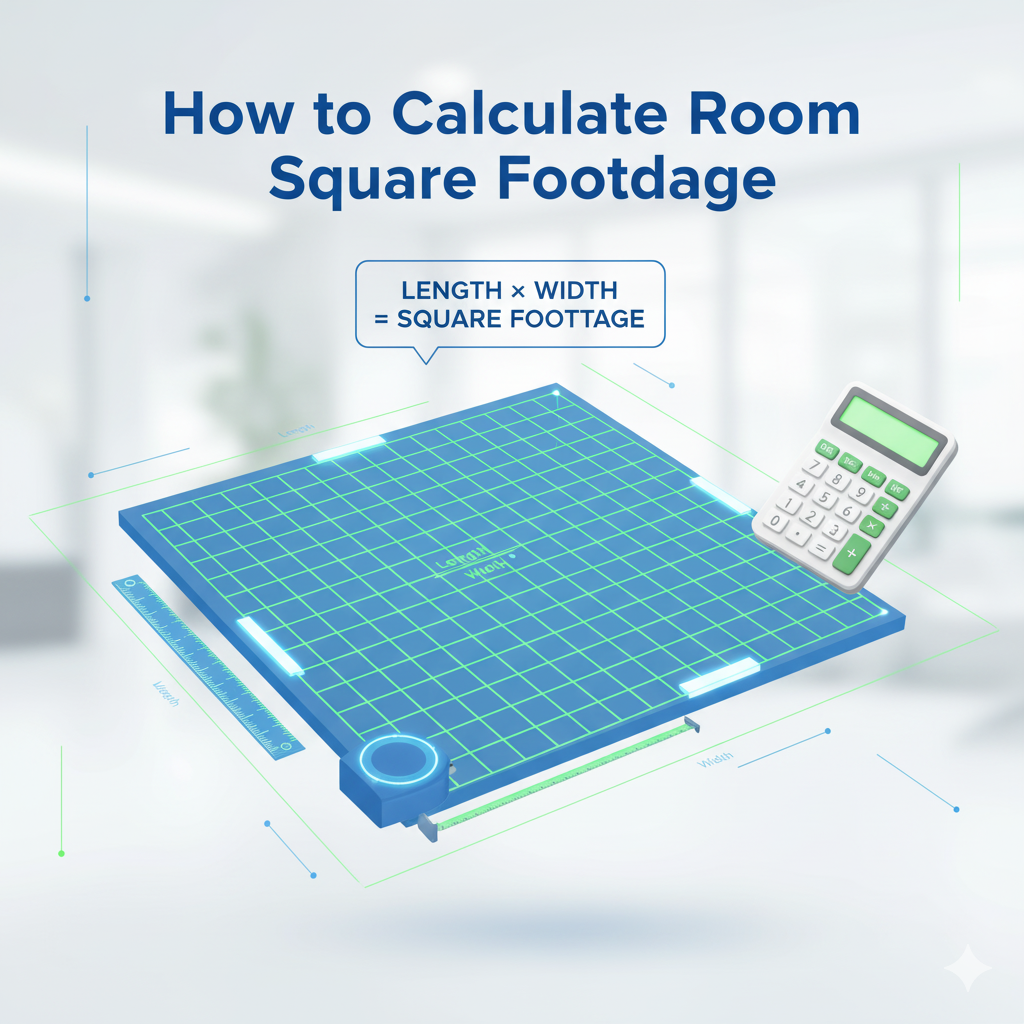
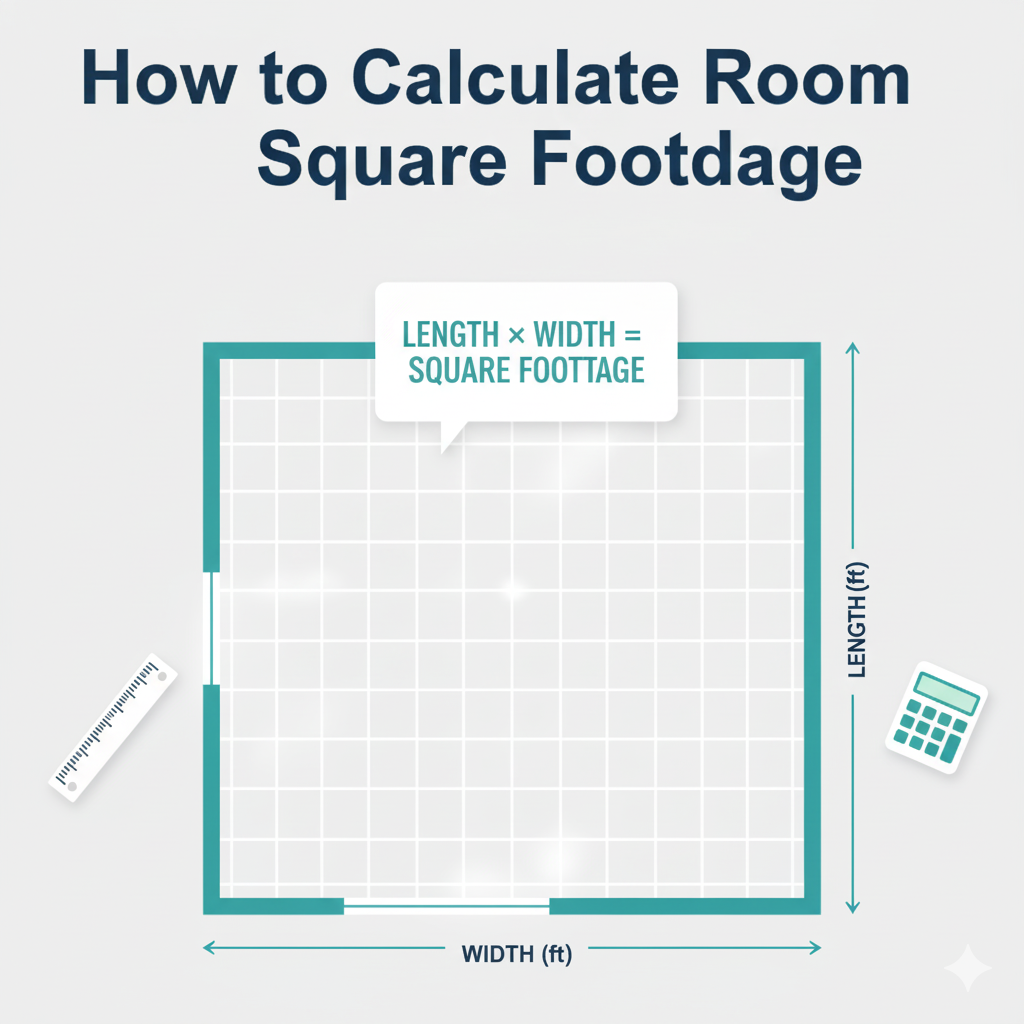
Other guides usually kick off by explaining what square footage is and why measuring it matters. For instance, a lot of them stress that for basic rooms, it’s just “Length × Width = Area.”
Competitor Headings & What They Cover (to Borrow + Improve)
After checking out different sites, here are some common headings folks use when explaining how to figure room square footage, plus what’s typically in them and how I’ll expand on it:
How to Calculate Room Square Footage Easily — measure length, measure width, multiply, optionally convert inches.
Measuring in Odd-Shaped Rooms — splitting irregular shapes into rectangles, triangles, adding areas.
Why Measure Square Footage / Importance — cost estimation, material planning, comparisons.
Step by Step Guide / Tools Needed — tools, methods, measuring tips.
Accounting for Waste / Extras — extra material, cutting loss etc.
I’ll stick to a setup that includes those but also dives deeper into shapes, quirky corners, switching units, balancing precision and quickness, and more.
Step-by-Step: How to Measure and Calculate a Room’s Square Footage
Here’s a clear walkthrough you can use to get dependable measurements.
Preparing to Measure
Before you jump in, clear out the room—move furniture or big stuff so you can get from wall to wall without hassle. Grab these:
A tape measure (or a laser one)
A notepad or your phone for notes
A calculator (your phone works fine)
Maybe some graph paper or a sketchbook to draw the room
The right gear cuts down on errors, and sketching lets you spot weird shapes or cutouts right away.
Measuring Length and Width
Find the longest wall; that’s your length. Then the widest one perpendicular to it; that’s width. Measure both right from wall to wall, down at floor level, without anything blocking.
If there are baseboards or trim, measure to where the flooring stops (often at the baseboard), or just stay consistent based on what you’re covering.
Converting Units If Needed
Measurements often mix units: feet plus inches, or even meters. For square footage in the U.S. style, get everything into feet (use decimals for fractions).
Inches? Divide by 12 to make feet.
If you’re in metric (meters, centimeters), switch to feet (1 meter is about 3.28084 feet).
Lots of guides mention this. Skipping it can cause major mistakes in rounding.
Basic Formula for Regular Rooms
For a plain rectangular or square room: length times width (in feet) gives square footage.
Like: a room 14 feet long, 12 feet wide → 14 × 12 = 168 sq ft.
That’s the core; for plenty of rooms, it’s all you need. But most aren’t that basic.
Handling Irrregular Rooms
If the room has a little bump-out, a bay window, or an L-shape:
Split it into smaller, easier shapes like rectangles, squares, or triangles.
Measure each bit separately (length/width or base/height, whatever fits).
Figure the area for each.
Add them all up for the total.
Take an L-shaped room: Part A (12 × 10 = 120 sq ft) + Part B (8 × 6 = 48 sq ft) = 168 sq ft.
Other content covers this in sections on “odd-shaped rooms” or “complex floor plans.”
Common Shapes and Their Area Formulas
Knowing how to calc different shapes helps when rooms aren’t straight rectangles.
Rectangle / Square: Area = Length × Width
Triangle: Area = (Base × Height) ÷ 2
Circle or Semi-circle: Area = π × (Radius)² (or half of that)
Trapezoid: Area = ((Base1 + Base2) ÷ 2) × Height
With these, you can handle curved or slanted walls. Say, a semi-circular bay window with a 3-foot radius → half-circle area = (½) × π × 9 ≈ 14.14 sq ft.
Guides often list these, especially for carpet, flooring, or tile work.
Examples: Putting It All Together
Here are some everyday examples to show how it works.
Example 1: Basic Bedroom
A straightforward rectangular bedroom, 12 ft by 10 ft. Walls are normal, no extras.
Calc: 12 × 10 = 120 square feet.
Example 2: L-Shaped Living Area
Living room in an L. One part 15 ft × 10 ft = 150 sq ft. Other 6 ft × 8 ft = 48 sq ft. Together = 198 sq ft.
Example 3: Room with Bay Window or Semi-Circle
Main area: 14 ft × 12 ft = 168 sq ft. Bay is semi-circular, radius about 3 ft → semi-circle = (½) × π × 9 ≈ 14.14 sq ft. Total ≈ 182.14 sq ft.
Example 4: Incorporating Closets or Obstructions
Room with a built-in closet: main 12 × 12 = 144 sq ft. Closet 4 × 6 = 24 sq ft. If usable, add for 168 sq ft. If not (unfinished or blocked), subtract based on what you’re doing.
Adjusting for Waste, Material Overlap & Allowances
For flooring, carpet, or tiles, you won’t use exactly what you measured. Trims, matching patterns, cuts around edges all create waste. Other guides suggest adding 5-10% more; bump it up for tricky shapes or diagonal installs.
So, take your square footage and multiply by (1 + waste percentage). Like, 200 sq ft plus 10% → get 220 sq ft worth.
Tools & Technology for Speed and Accuracy
Measuring by hand is fine, but tools make it quicker and sharper.
Laser measurer: Perfect for long or awkward spots.
Phone apps: Some let you snap pics, trace walls, and calc area on the spot.
Online calcs: Plug in numbers, shapes, get results fast. Many handle mixed units.
Blueprints or plans: If you’ve got drawings, use those sizes (check the scale though).
Others often have interactive tools, converters, templates.
Accuracy vs Speed: When Enough Is Enough
Sometimes you need dead-on accuracy (for big tile buys, custom floors, property values). Other times, a rough idea is okay (furniture planning, small fixes).
For quick: Use rough measures (round to inch or foot), skip tiny nooks if they won’t matter.
For precise: Check every corner, wall, under windows, closets. Convert inches exactly. Use good tools.
Think about why you’re measuring; don’t overdo it when it’s not necessary, but don’t cut corners when it counts.
Mistakes People Make and How to Avoid Them
From watching DIY folks and even pros trip up, here are common gotchas:
Mixing units: Length in feet, width in inches, no conversion → bad math.
Rounding early: Doing it before multiplying builds up errors.
Forgetting small bits: Closets, bays, alcoves, fixtures often overlooked.
Assuming squares: When things are angled or curved.
Skipping waste: Buy too little, stall the job.
Wrong formula: Using rectangle for trapezoids or triangles.
Dodge them by sketching, verifying, picking right formulas, noting odd parts.
When Square Footage Includes / Excludes Features
Based on what you’re doing, you might add or skip certain areas:
Finished vs raw: For floors or paint, skip unfinished spots (crawls, bare closets).
Built-ins or blocks: Big cabinets, counters cut usable floor (or coverage).
Window/door holes: For walls (paint, paper), subtract. For floors, usually not—floor’s still there.
Ceiling height: Square footage is flat floor only, not 3D. High ceilings don’t change it.
Know your goal from the get-go.
Adding Multiple Rooms and Floors
For whole house or several rooms’ total:
Measure each room using the method (length x width or breaking down).
Add hallways, closets, inner areas if they fit your needs.
Sum everything.
For multi-level places, do each floor separate—ground, upstairs—and add. Consider heights, finishes if relevant (unlike basic footprint).
Example Scenarios for Real Life Context
To get a better sense, here are fuller stories:
Case A: Painting a Room
Painting walls in a 14 × 12 ft room (168 sq ft floor). 9 ft high. Four walls:
Two: 14 ft × 9 ft = 126 sq ft each → 252 sq ft
Two: 12 ft × 9 ft = 108 sq ft each → 216 sq ft
Total walls = 468 sq ft
Minus windows/doors: say 30 sq ft → 438 sq ft to paint.
Case B: Replacing Flooring in an Odd Plan
Family room plus nook: main 16 × 14 = 224 sq ft; nook 6 × 8 = 48 sq ft. Total 272 sq ft. Plus 10% waste → about 299 sq ft.
Case C: Converting From Metric
Measured in metric: 4.5 m × 3.8 m = 17.1 m². For sq ft: 17.1 × 10.7639 ≈ 184 sq ft.
Glossary: Terms to Know
Square Foot / Sq Ft / Ft²: Area unit for a 1-foot square
Area: Space inside a boundary
Foot / Feet: Length, 12 inches each
Inches: 1/12 foot
Waste / Overrun: Extra for trims, matches, errors
Irregular Shape: Not rectangle or square (L, curves etc.)
Tools & Templates to Help
Checklists, templates, tools cut errors and save time.
Printable sketches: Draw, mark sizes
Apps for layouts
Online calcs for mixed units, shapes
Material tools with waste, patterns
Other sites often offer calcs or templates for room square footage.
FAQs: For “How to Calculate Square Footage of a Room”
Closing Thoughts On How to Calculate Room Square Footage
Measuring room square footage is a key skill for homeowners, DIY fans, real estate people, and anyone planning spaces. Once you master careful measuring, unit switches, shape breakdowns, and waste planning, it feels natural.
Doing it right means fewer headaches: less wasted stuff, better budgets, easier renos, fairer prices, and smarter use of space.