

How to Calculate Square Footage — Easy Step-by-Step Guide
Introduction: Why Square Footage Matters
Square footage isn’t just some random figure—it’s basically the way we talk about size in real estate, design, and building projects. Whether you’re shopping for a new house, getting ready for a remodel, figuring out how much paint you’ll need, or estimating costs for new floors, having the precise area of a space can really help you avoid wasting money, time, and energy.
A lot of folks end up wondering the same thing: how do you actually calculate square footage? It might seem a bit overwhelming at the start, but once you get the hang of measuring length and width and using the proper formula, it turns into something you can do without thinking twice. In this guide, we’ll cover not only the everyday calculations but also some trickier approaches for odd-shaped areas, outdoor jobs, and even roofs.
When you’re finished here, you’ll be able to measure any kind of space with total ease.
The Basics of Square Footage
Square footage is really just a way to measure area in square feet (sq ft or ft²). It tells you how much ground or surface a room or spot takes up.
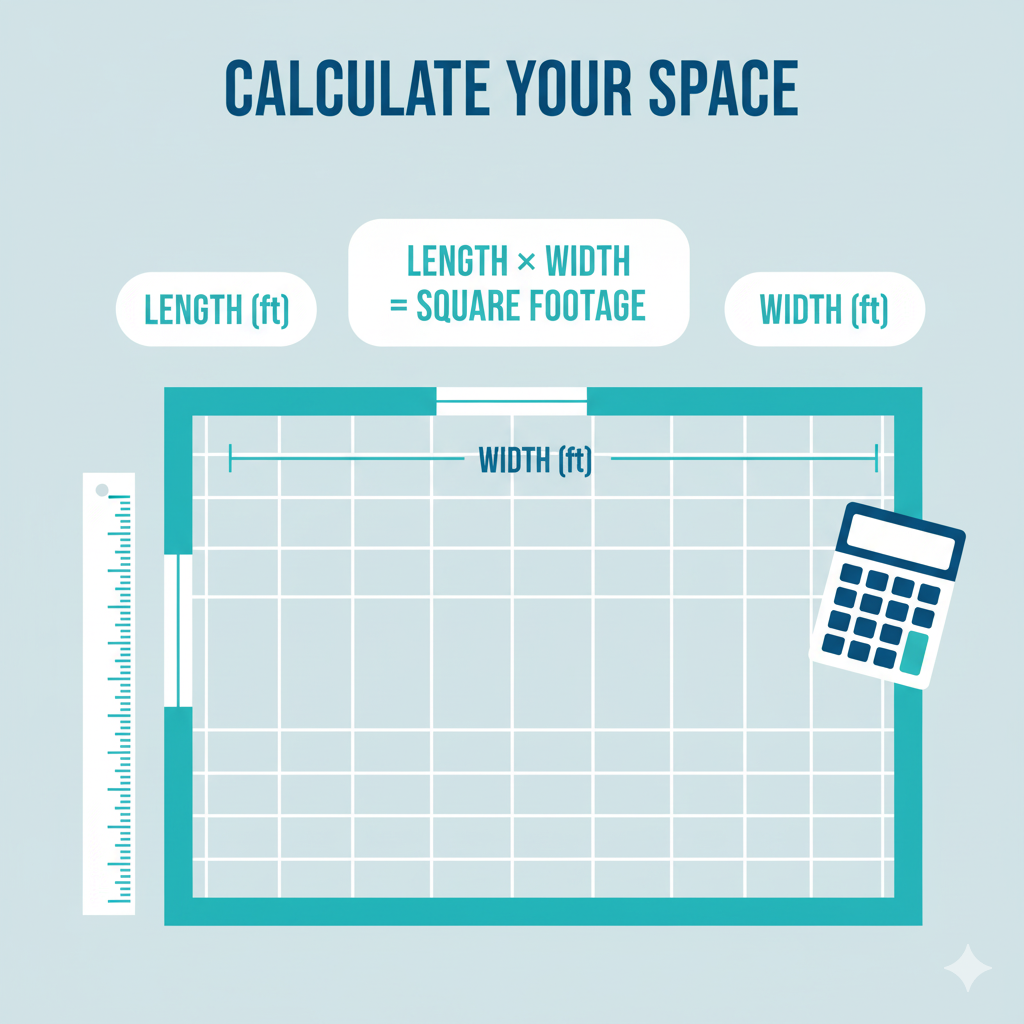
The simple formula is this:
Square Footage = Length × Width
Take a bedroom that’s 12 feet long and 10 feet wide, for instance:
12 × 10 = 120 square feet
See? You’ve got your first area calculation under your belt.
Step 1: Gather Your Tools
Before you dive in, grab the tools that’ll help you get spot-on measurements. You don’t have to go fancy—stuff you probably have around the house will do just fine.
Tape measure: The go-to option, often stretching 25–50 feet.
Laser measure: Great for fast, super-precise readings, especially in bigger spaces.
Notepad and pencil: For jotting down your figures.
Calculator or phone: To handle the math quickly.
Graph paper (optional): Comes in handy for sketching room setups to scale.
With these on hand, you’ll steer clear of slip-ups down the line.
Step 2: Convert All Measurements to Feet
Sticking to the same units is crucial when you’re figuring square footage. If you’ve got some numbers in inches and others in feet, your results will be off.
To switch inches over to feet, just divide by 12.
Like this:
120 inches ÷ 12 = 10 feet
30 inches ÷ 12 = 2.5 feet
This is particularly key when you’re dealing with furniture, appliances, or plans that might show sizes in inches.
Step 3: How to Calculate Square Footage of a Room
Let’s tackle this room by room and walk through how it works.
Rectangle or Square Rooms
The easiest one:
Length × Width = Square Feet
For example:
Living room: 15 feet long × 12 feet wide = 180 sq ft
Irregular Rooms
Houses aren’t always neat boxes. For those wonky spaces:
Split the room into smaller rectangles or squares.
Measure each part on its own.
Add everything up for the full total.
For instance:
An L-shaped room breaks into two rectangles.
First one: 12 × 10 = 120 sq ft
Second one: 8 × 6 = 48 sq ft
Total = 168 sq ft
Square Footage Formulas for Different Shapes
Triangle
Formula: (Base × Height) ÷ 2
Example: (10 × 6) ÷ 2 = 30 sq ft
Circle
Formula: π × Radius²
If the radius is 5 ft: 3.14 × 25 = 78.5 sq ft
Trapezoid
Formula: (Base1 + Base2) ÷ 2 × Height
Example: (8 + 12) ÷ 2 × 6 = 60 sq ft
Getting comfortable with these lets you tackle pretty much any setup.
Step 4: How to Calculate Square Footage for Flooring
Flooring prices hinge right on square footage. To get an idea:
Measure every room.
Total up the square footage.
Multiply by the cost per square foot for the flooring.
Throw in 5–10% more for scraps from cutting.
Like this:
If the whole space is 500 sq ft and flooring is $4 per sq ft:
500 × 4 = $2000
Add 10% for waste = $2200 rough estimate.
Step 5: Calculating Square Footage for Walls (Painting)
For painting a room, you want the square footage of the walls.
Formula: Wall Area = (Height × Length) × Number of Walls
For example:
A room with 4 walls, each 10 ft high and 12 ft wide:
10 × 12 = 120 sq ft per wall
120 × 4 = 480 sq ft
Pull out areas for windows and doors to be more exact.
Step 6: Calculating Square Footage for Roofs
Roofs need a different approach because of the angles.
Formula for a basic gable roof:
Roof Area = Building Footprint × Roof Pitch Multiplier
Pitch multipliers change based on the slope:
4/12 pitch = 1.054
6/12 pitch = 1.118
8/12 pitch = 1.202
For instance:
House base: 40 × 30 = 1200 sq ft
With 6/12 pitch: 1200 × 1.118 = 1341.6 sq ft roof area
Square Footage in Real Estate
Square footage plays a huge role in how much a property is worth. Buyers like to stack up homes by price per square foot. That’s why getting it right matters—a wrong number could make a place seem pricier or cheaper than it is.
Gross Living Area (GLA): Counts only finished spots with heat.
What doesn’t count: Garages, basements, attics—unless they’re done up.
Check local rules for real estate always.
Square Footage in Landscaping and Outdoor Projects
When you’re setting up sod, putting in a patio, or adding a deck, square footage calculations are a must.
For example:
Backyard patio: 20 × 15 = 300 sq ft
If pavers are $5 per sq ft → $1500 for the job estimate
Knowing your figures means you won’t overbuy or come up short on materials.
Common Mistakes When Calculating Square Footage
Jumbling feet and inches without switching them over.
Skipping alcoves or closets.
Missing sloped ceilings or spots you can’t use.
Not planning for waste in flooring gigs.
Guessing by eye rather than measuring.
These little oversights can turn into big headaches with supplies and budgets.
Advanced Tools: Square Footage Calculators
Doing the math by hand is solid, but online tools speed things up. Square footage calculators let you punch in numbers and get answers right away. Some apps even allow drawing out rooms for auto-calcs.
Perks include:
Quick and precise results
Switching between feet, inches, meters
Tackling complicated shapes
Real-Life Examples and Case Studies
Example 1: Home Renovation
A homeowner is after new carpet for the main bedroom.
Room: 14 × 16 = 224 sq ft
Carpet: $3 per sq ft
Total = $672
Plus 10% waste → $739
Example 2: Office Space
An office boss needs to figure space for desks.
Office: 30 × 20 = 600 sq ft
Each desk takes 40 sq ft:
600 ÷ 40 = 15 desks can fit nicely
Example 3: Real Estate Listing
A realtor sizes up a two-bedroom place.
Living room: 12 × 15 = 180 sq ft
Bedroom 1: 10 × 12 = 120 sq ft
Bedroom 2: 12 × 12 = 144 sq ft
Kitchen: 10 × 8 = 80 sq ft
Total = 524 sq ft
Spot-on numbers help price it right for the market.
Pro Tips for Accurate Measurements
Measure everything twice.
Round to the closest inch, then convert.
Tag each measurement clearly.
Sketch on graph paper.
Remember closets, halls, small nooks—they count too.
FAQs on How to Calculate Square Footage
Conclusion: How to Calculate Square Footage
Figuring out how to calculate square footage is one of those handy skills that keeps giving back. From house hunting to home fixes, new floors to fresh paint, nailing the exact area means better accuracy, less spending, and smoother planning.
Once you’ve got the formulas down and feel good about measuring, you’ll see it’s no big deal—just straightforward math with big payoffs. No matter if you’re owning, renting, investing, or building, knowing square footage puts you ahead in any endeavor.